
March 2, 2026 – The fourth annual Big E-shop Test brought several new features. In addition to the traditional evaluation of the complete customer (post-)purchase experience at medium and large e-shops, the test also focused on marketplaces, comparisons with German e-commerce stores, and transactional emails. For the first time ever it took place during Black Friday – the busiest day of the logistics season. As a result, it provided valuable data on e-shops’ actual readiness for extreme operational loads. The test was backed by a stable trio of experts in their respective fields – Shopsys was responsible for the ordering process, Skladon for logistics, and Retino evaluated the quality of return processes. For this year’s edition, an expert on expansion into the German market – BridgeMarket – was also newly invited to participate.
More than 200 e-shops from 16 product segments were involved in the test – ranging from sellers of dietary supplements to specialized e-shops selling furniture or gardening equipment. New this year was the expansion of the project to include a division focused on online retailers specializing in the German market, as well as the inclusion of orders from the largest Czech and foreign marketplaces, which are becoming increasingly prominent in the Czech Republic.
Testing took place on the busiest logistics day of the year
The practical part of the test consisted of ordering one small product in stock from each e-shop, with an approximately value of CZK 500. For delivery, the cheapest available carrier with delivery to the address was always selected in the shopping cart. All orders were completed on Friday, November 28, by 12:30 p.m. so that no e-shop would be a disadvantaged in terms of delivery time.
The overall rating was based on more than 85 selected metrics, and the test included e-shops operating in the Czech Republic that ship at least 1,000 orders to end customers per month.
“We deliberately launched this year’s edition on Black Friday, which is always the most logistically demanding day of the year for us. We also included several new features in the test, including an expansion of the metrics monitored. Thanks to this, this year’s results are even more informative and represent a comprehensive guide for every e-shop owner,” says Tomas Kohut, CMO & Customer Care Leader at Skladon.
The ordering processes of Czech e-commerce sites reflect a growing emphasis on customer convenience as well as changes in shipping and payment standards
The ordering part of the test was conducted exclusively on mobile devices and focused on customer purchasing behavior within the shopping cart and throughout the entire ordering process. The results are based on more than 15,000 monitored parameters and reflect the typical customer experience during the busiest time of the year.
There has been a significant shift at the top of the market in the transportation sector. For the first time, PPL has become the most commonly offered carrier for home delivery, chosen by 62% of e-shops (+10 percentage points). After a long period of dominance, Czech post has thus fallen to second place with a 54% share (-7 percentage points). There has also been a gradual decline in Packeta’s share of home delivery, which was available at 24% of e-shops, while it continues to hold the leading position for pickup points (79%). PPL follows with 50%, having strengthened its position year-over-year.
“We’re seeing that e-commerce sites are increasingly working with multiple carriers to offer customers more flexible delivery options. At the same time, however, preferences are gradually shifting, with players offering a high-quality network of pickup points and reliable door-to-door delivery coming to the forefront,” adds Petr Krakowczyk, CMO of Shopsys.
An interesting comparison is provided by marketplaces, which differ significantly from standard Czech e-shops. In most cases, they do not allow customers to choose a specific carrier and operate with a predefined platform solution. At the same time, free shipping is more commonly offered regardless of the order value; 44% of marketplaces utilize this, while only 6% of Czech e-shops do. This difference highlights a distinct approach to customer experience management and pricing strategy.
New options continue to expand in the area of payments and additional services. The option to add a tip has appeared at nearly 10% of e-shops, representing more than a twofold year-over-year increase. The use of QR payments is growing even more significantly, with more than a quarter of e-shops now offering this option. Nevertheless, cash on delivery maintains a strong position, being available at 92% of e-shops, which confirms its long-term relevance in the Czech market.
The ordering process itself and its clarity have also seen positive developments. Today, 83% of e-shops display the individual steps of the ordering process, and there is an increasing trend toward reducing distractions, such as hiding product navigation during the purchase. At the same time, e-shops are making greater use of visual elements, such as logos for shipping carriers and payment methods, and are paying more attention to the customer’s overall navigation experience during the ordering process.
“From a UX perspective, ordering processes are improving year over year across most of the metrics we track. E-commerce sites are focusing more on clarity, simplifying steps, and handling information throughout the purchasing process. However, we still see space for improvement, particularly in terms of transparency regarding shipping and pricing before the actual order is placed,” adds Shopsys’s marketing director.
The most significant logistics trend this year is the continuing acceleration in parcel delivery.
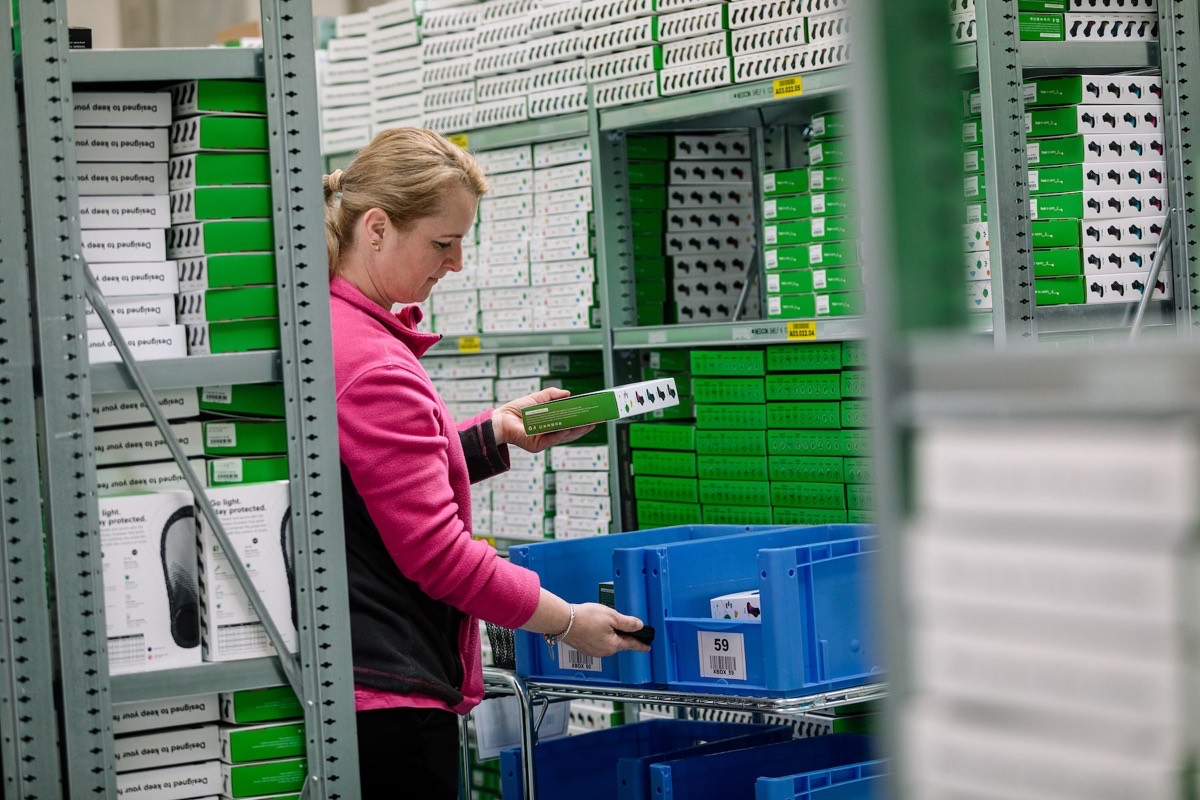
The logistics part of the test began with the delivery of packages to Skladon’s distribution center, where key metrics were then evaluated – in particular, delivery speed and accuracy, packaging quality, environmental approaches, and the use of brand elements on shipments.
D+1 delivery, i.e., delivery on the next business day, was achieved for 66% of shipments, representing a year-on-year increase of 12 percentage points. To achieve this result, orders had to be delivered by Monday, December 1, 2025, at the latest. Another 19% of shipments were delivered in D+2 mode, 7% in D+3 mode, and 2% in D+4 mode. A pleasant surprise was also the weekend delivery service provided by Czech post, which was the only carrier to deliver ten shipments from the tested e-shops on Saturday, November 29. By strengthening its weekend shifts, it is responding to the busiest days of the logistics season.
“We are seeing a gradual annual acceleration in delivery speed metrics. It was only last year that we exceeded the 50% mark for the first time, and this year almost two-thirds of e-shops have delivered to the D+1 regime. We expect this positive trend to continue in the coming years,” comments Tomas Kohut, CMO & Customer Care Leader at Skladon.
A negative finding this year remains the delivery date notification in shopping carts and its subsequent consistency with the actual delivery date. Information about the expected delivery date was available in the shopping cart for only 45% of e-shops, with only 51% of them actually meeting the notified deadline. Another 39% of e-shops delivered the shipment earlier than declared, and 11% after the announced date.
“Every year, I am surprised by the low rate of delivery date notifications directly in shopping carts. Customers deserve much more care when it comes to being informed about the status of their orders, especially before Christmas. At least the year-on-year increase of 36% compared to last year is positive, which already represents a statistically significant change,” adds Tomas Kohut.
While the error rate for shipments was 4% last year, only one incorrect package was recorded across the entire sample of e-shops tested this year. In this case, a human error occurred during picking and shipping, when the e-shop accidentally sent 12 identical items instead of one ordered product.
Brand visibility on packaging was recorded in 67% of e-shops, compared to 64% last year. Gifts or promotional materials were included with the shipment by 33% of stores, most often in the form of discount codes, catalogs, or small gifts. Personalization in the form of handwritten messages, signatures, or stickers was used by 8% of e-shops, confirming the trend toward further standardization of logistics processes, especially among larger players in the market.
Filling material was used by 53% of e-shops, even though only 5% of shipments contained fragile products. A positive sign is that 62 % of the filling material used consisted of eco-friendly options. At the same time, the proportion of printed invoices in packages decreased significantly, by 9% compared to last year.
“There is still a problem with the use of disproportionately bulky packaging materials, where the filling often serves only to fill excess space. In rare cases, there have even been instances of combining multiple types of fillers in a single package, which worsens both the customer experience and the environmental impact,” adds Tomas Kohut, CMO & Customer Care Leader at Skladon.
Return processes remain a weak part of the customer experience and a challenge in the context of new legislation
Unlike the ordering process and delivery – areas to which e-commerce sites have long devoted considerable attention – returns remain one of the least developed aspects of the customer experience. Yet it is precisely when a customer returns an item that their overall impression of the purchase and their willingness to shop at the e-commerce site again are fundamentally shaped.
A key factor in this year’s test was the readiness of e-shops for upcoming legislative changes. Starting in June 2026, merchants will be required to provide customers with an easy and clearly accessible method for withdrawing from a contract, typically via an online form. However, the current situation shows that a large portion of the market is not yet prepared for this change. Today, 56% of e-shops lack an online return form, while 41% offer it without restrictions and 3% only under specific conditions. Although this represents a year-over-year improvement, the pace of adaptation remains relatively slow.
“The upcoming legislation sets clear rules that e-commerce sites will have to comply with. At the same time, however, it’s not just about compliancen – a well-designed returns process can significantly streamline internal operations while also improving the customer experience,” comments Petr Boros, CEO of Retino.
The legal 14-day return period remains the standard for most online stores. Only 27% of them offer an extended return period, which, despite a slight year-over-year improvement, indicates a relatively low level of customer-friendly service in this area.
At the same time, it appears that e-commerce sites are doing very little to treat returns as a business opportunity. Only 15% of e-commerce sites actively engage with customers during the process, for example by offering to exchange the item or provide an alternative product. Although this represents a year-over-year increase of 9 percentage points, most e-commerce sites still fail to capitalize on this potential.
“Online stores still often view returns primarily as a cost. However, it is precisely this phase that can determine whether a customer returns. Those who can leverage it as part of their business strategy gain a significant competitive advantage for the future,” adds Petr Boros.
Applications of the results for e-shops, experts, and end customers
Thanks to an extensive evaluation of more than 200 e-shops and the examination of more than 85 metrics, this year’s results of the Big E-shop Test offer a wide range of uses. The data obtained is beneficial not only for e-commerce merchants themselves or other experts, but also for end customers who want to better understand the quality of the services provided.
By downloading the results, readers will gain an overview of how the tested e-shops performed in terms of the ordering process, logistics, and return services, including a year-on-year comparison. This will give them a more accurate picture of how the major online players on the Czech market operate in key (post-)purchase areas.
The complete results of the Big E-shop Test are available for free download at www.velkytesteshopu.cz.